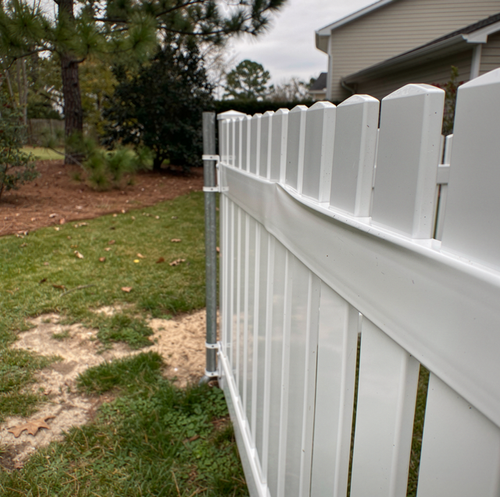
A length of vinyl fence, whether it becomes a picket, a rail, or a post, starts as a hollow shape pushed through a die, with the die setting the outer profile and the wall running around that hollow at the same time. For a given outer shape, stiffness comes from that wall and from how the ribs inside are arranged to brace it. Two panels can share the same style, the same height, and the same finish, and still carry a different amount of material holding that shape up, which is why a run that looks fine on install day can bow, ripple, or crack at a fastener hole once heat, wind, and time work on it.
Each part of a vinyl fence carries its own wall, and each shows a thin one in its own way, set against what a buyer can check on a sample or an installed run:
| Part | What a Thin Wall Does There | What to Check |
|---|---|---|
| Pickets or privacy boards | Ripples or bows along the face, cracks at a fastener | Flex a board by hand at the middle of an unsupported span |
| Top rail | Sags between posts on a long run | Sight down the rail on a sample section for an existing bow |
| Bottom rail and any metal stiffener inside | Sags first along its length, carrying every picket's bottom edge | Ask whether a stiffener runs inside the bottom rail, and feel for it near a cut end |
| Posts | Ripples or leans at the top under a steady push | Press on a post above the ground line and feel how far it gives |
| Gate frame and gate posts | Frame flexes at the latch side; post takes the swinging load | Ask the same wall question about the gate frame, and how the gate post is set |
| Caps and brackets | Cracks where a screw seats, work loose in heat | Look at how the cap is fastened, not only how it sits on top |
Why Wall Thickness Sets Stiffness
A picket or a rail resists a side push the same way any hollow shape resists bending: the material in its wall, and the ribs that brace that wall from the inside, carry the load. A wall with more material, arranged with deeper internal ribs, bends less under the same push than a thinner wall cut to the identical outer shape. From ten feet back, a buyer sees the profile and the color; the wall doing the structural work sits out of sight the entire time, which is exactly why two panels that look the same on a showroom stand can behave differently once they are standing in a yard for a season.
The Bottom Rail and Why It Sags First
The bottom rail carries the bottom edge of every picket across the panel's full width, holding them aligned while sitting closest to standing water, mower contact, and whatever gets kicked against a fence line over the years. That combination of a long unsupported span and steady contact puts real demand on the bottom rail's wall on its own, apart from what the pickets or the top rail carry. A reinforced bottom rail addresses that by carrying a metal stiffener inside the hollow, adding strength across that span that the wall alone would not provide. A bottom rail built without a stiffener is asking its wall thickness to do that whole job alone, and a thin wall on that particular piece has more reason to show there than on a part carrying a shorter span or less contact.
Heat and Sun on Vinyl
Vinyl softens some as it warms, and that is part of how a thin wall shows itself over a season: a thin-walled panel can take a bow in the heat that a thicker wall resists. A run that faces a window or a light-colored wall can pick up reflected heat on top of direct sun, which is worth knowing when a fence sits close to glass. Full sun is where the difference shows: a panel with enough material in its walls holds its shape, while a thin-walled one can bow.
Wind and Impact
A hard, sudden hit, whether from a thrown ball, a dropped tool, or equipment bumping a run, can crack a thin-walled picket or rail outright rather than just flex it, since a crack starts where the wall has the least material to spread the impact. Wind loads a panel differently, pushing on it steadily rather than striking it once, and the load a given run carries turns on the panel style and how exposed the run is.
A cracked vinyl picket or rail can leave a sharp edge at the break, a cut risk for a child or pet nearby. A bowed or cracked pool-fence panel is a safety gap the contractor closes; the gate is latched until then.
Gates and Gate Posts
A gate built from the same hollow profile carries its weight off the hinge side of the frame with every swing, so the same wall-thickness question that applies to a fixed panel applies to the frame rails on a gate as well, and the post the gate hangs from takes that swinging load in addition to whatever a line post carries along the rest of the run. Where the hinges and latch are screwed into that frame wall, a thin frame rail leaves each screw with less material to hold.
Comparing Quotes and Samples on the Same Terms
A quote that names a style and a color without naming the wall for that specific product line has not named enough to compare against a second quote, even when both describe a "privacy" or "solid" panel in the same words. Ask to see or hold a cut piece of the product being quoted, not only a finish swatch or a photo, and flex it by hand the way a panel would flex once it stands unsupported between posts. Ask whether the bottom rail on that line carries a stiffener, and ask how the gate posts and line posts are set into the ground. Two quotes describing the same style in the same words can still be naming two different products once the wall and the rail inside each one are compared side by side, and the fence that goes into the ground should match the one that was measured, not just the one that was pictured. Vinyl is ordered to a specific style, color, and product line rather than pulled off the shelf on the day of the estimate, which is another reason to confirm the wall thickness for the exact line being ordered, not a general sample kept in a showroom. Two cut pieces of the same size and style also carry different amounts of weight when the wall inside them differs, so picking up a sample from each quoted line, side by side, provides a second way to compare the same claim in hand rather than by eye alone.
Frequently Asked Questions
Can a bowed vinyl panel be swapped out without replacing the whole fence?
A single panel and its posts can be replaced in place, matching the style of the surrounding run, rather than tearing out the entire fence line. As part of that swap, the utility locate service is called before any post is dug out or reset.
Does color change how much wall thickness matters on a vinyl fence?
Color affects how much of the sun's heat a panel absorbs, and a darker panel absorbs more than a white one. Since vinyl softens as it warms, a darker run in full sun asks its wall to hold shape at higher surface heat, which makes the wall question its choice of a darker color for a sunny line.
If a sample panel feels stiff in a showroom, does that prove the wall is thick enough?
Not on its own. A showroom sample is a short-cut piece, and a short span resists flex more than the same profile does across the full unsupported span it stands on between posts. A hand test on a short cutoff is a starting point, not a substitute for asking for the wall measurement itself.
Do gate frames carry a different wall than the panels next to them?
Within one product line, a gate frame can share the same wall as the fence panels beside it, but a heavier stiffener can be added inside the frame rails at the point of manufacture specifically because the frame carries the extra swinging load a fixed panel never sees, and a quote can state whether the gate being priced carries one.
Can wall thickness differ between the posts and the panels on the same fence line?
Yes. A fence line puts more load through the posts, which carry the whole run at fewer points than the panels spread that same load across, so a product line can put a heavier wall in its posts than in its panels. Wall thickness is worth asking about part by part, not assumed to be uniform across an entire fence.
How can a buyer see the wall thickness on a sample?
At a sawn end. A cut end of a rail, picket, or post shows the wall and the internal ribs in cross-section, and a caliper laid across that edge reads the wall directly, while a capped or finished end hides both.
Order vinyl fence installation or panel and post replacement — reinforced bottom rails, hollow posts set in concrete, and panels and posts matched to an existing run. Crusberg Fence serves Yorktown and the Virginia Peninsula. Call (757) 508-0538.