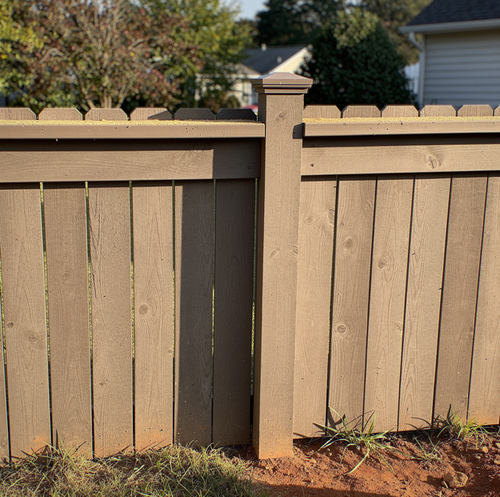
Both styles start from an ordinary wood fence and build on top of it, where a plain run would otherwise leave the cut end grain of every picket top exposed to the weather. Cap-and-trim runs a flat board across the top of the run, covering the post tops and the cut ends of the pickets, with a second, narrower board mounted just below it along the picket faces. Picture-frame goes further: it boxes in each bay between two posts on three sides, top and both edges, rather than covering the top alone. That's the one difference that shapes how each style looks, what it protects, and what it takes to fix later.
Feature by feature, the two styles compare like this:
| What It Covers | Cap-and-Trim | Picture-Frame |
|---|---|---|
| Where the added boards sit | Across the top of the run | Across the top and down both sides of each bay |
| What covers the post tops | One cap board, running the length of the run | Each bay's top trim stops at the post, so the post top is finished on its own |
| What covers the pickets' top end grain | The cap board's underside | The top trim piece inside each framed bay |
| Which face shows the trim | Trim board on one face or both; the cap reads from both sides | Can be built to show on one face or both |
| What comes off to replace one picket | Cap and trim fasteners over that picket, released and reset | The bay's side trim, since it overlaps the picket's outer edge |
| How the run reads from a distance | One continuous line at the top | A row of separate framed panels |
The Cap Board Over the Post Tops and Board Ends
A cap is a flat board laid across the top of the fence, fastened down into the post tops and the tops of the pickets as it runs the length of the run. It covers the exposed end grain of the posts and pickets in a single continuous line. End grain takes on water faster than the flat face of a board, since the open pores at a cut end pull moisture straight in rather than shedding it the way a board's sealed face can. Covering that end grain with a cap keeps rain from soaking down into the top of a post or a picket.
That protection only holds up if the cap's own top surface does its job. A cap sits with its whole top face turned up to the sky, and how it's set decides whether it sheds water or holds it. Set flat, with no pitch to carry water off, a cap can hold a thin film after rain, feeding the same kind of moisture problem it was added to stop. Set with even a slight pitch away from the fence face, the same board sheds that water instead of sitting in it. The cap protects what's under it, and it has its own question about water to answer at the same time.
The Trim Board Under the Cap and the Line It Draws
The trim board mounts on the picket face just below the cap, narrower than the cap itself. It covers no end grain; its job is to give the top of the run a finished line and a surface for the cap to land on beyond the picket tops alone. A run built with a cap and no trim shows a plain edge above the boards. Adding the trim gives that top edge a shadow line and covers the small unevenness in picket height that a bare cap would leave visible along its lower edge. On some builds, the trim runs only the front face, leaving the back of the fence with the cap and plain picket faces, and nothing else added.
A butt joint in the cap board puts two cut ends side by side on the fence's top surface; landing that joint over a post gives both ends solid wood to fasten into, so neither end hangs past its support.
How a Picture Frame Boxes Each Bay
Instead of one trim board running the length of the fence, a picture-frame build treats each bay, the run of pickets between two posts, as its own panel. A trim board runs across the top of the bay much the way a cap-and-trim's cap does, and two more trim boards run up the sides, fastened to the posts on either side of that bay, so the pickets sit inside a border on three sides.
Where a cap-and-trim's trim is one strip broken only where it crosses a post, a picture frame's trim is broken and restarted at every post, since each bay carries its own frame rather than sharing one board with its neighbor. That per-bay framing is also what gives a picture-frame fence its look from a distance: each bay's border stops and starts at the post, so the eye catches a break there that a fence with a single cap running straight through doesn't.
Which Side Shows the Finished Trim
Whether the trimmed face or the plain picket face reads as the "finished" side follows the same logic that decides which face of any wood fence looks dressed and which reads as the working side. Cap-and-trim's trim board can run on the street face only, leaving the back with the cap and plain picket faces; picture-frame trim can be set to show on one face or both.
Swapping a Board Inside a Trimmed or Framed Bay
On a cap-and-trim run, swapping one picket means releasing the cap and trim fasteners over that picket, sliding the new board up under the cap, and refastening; the cap and trim themselves stay on the fence. On builds where the side trim laps the pickets' outer edges, reaching a picket near a picture-frame bay's edge means backing off that stretch of side trim first, setting the new picket, and putting the trim back, which means removing and resetting more fasteners for the same one-board repair.
A cap board or top rail flexes and can split or roll under a person's weight, dropping anyone standing on it onto the fence line below. Work at the top of the run is done by the crew from a ladder.
Picking Between Cap-and-Trim and Picture-Frame for Your Fence
The look you want at the top of the run is the first question: one continuous line, or a fence read as a row of individual panels. The second is which side faces the street or a neighbor's yard, since a cap-and-trim run shows a plain post-and-picket back on the side without trim, while a picture frame built to show on both faces keeps that same finished look from either side of the line. A gate built into the run can carry the same cap-and-trim or picture-frame finish so the whole run reads as one build, though its own bracing is a separate question from its trim. At the end post or where the fence turns a corner, the cap or trim is cut to close off the open end rather than run past it, on either style.
Frequently Asked Questions
Does a matching gate need its trim built any differently for a picture-frame fence?
Yes. A framed gate carries its own full border on all its edges, so the frame travels with the leaf, and the gap at the latch and hinge sides breaks the border where the gate meets the fence frame beside it; a cap-and-trim gate carries only a top cap and trim.
Can cap-and-trim run on the street side of a fence and the back run stay plain?
Yes, structurally. Where the trimmed section ends and the plain run begins, there needs to be its own end piece so the cap or trim stops cleanly at that post, rather than reading as if a section were simply left unfinished.
Does the trim get replaced along with the pickets when a board cracks?
Not always. Trim can outlast a single picket that failed on its own, since the board that cracks or splits isn't always the trim itself. But a stretch of trim pulled off more than once to reach several pickets over the years goes back up on new fasteners rather than the same holes, since repeated removal enlarges the original screw holes past the point where they hold.
Does a stepped run take a cap-and-trim or picture-frame finish?
Yes. A stepped run drops the fence height post to post to follow sloped ground; cap-and-trim's single running cap has to be cut and rejoined at each height change, while picture-frame's trim is already broken and restarted at every post, so each bay's frame sits at its own height.
Does one style leave more joints to seal than the other?
Each picture-frame bay adds corner joints where the top and side trim meet, and those cut edges and joints are extra end grain to seal at install; a cap-and-trim run has fewer of them, since its cap and trim run long between joints.
Does cap-and-trim or picture-frame work over a board-on-board or shadowbox pattern, or only a plain privacy fence?
Either finish can be built over those patterns, since the cap and trim mount to the top and sides of the bay rather than to a specific board pattern underneath. A picture frame also makes bay width visible: every framed section reads as its own panel, so bays laid out evenly from post to post keep those panels the same size along the run.
Hire a fence builder for a custom wood fence with a cap-and-trim or picture-frame finish — cap board, trim, and framed bays fitted to the board pattern you choose. Crusberg Fence serves Yorktown and the Virginia Peninsula. Call (757) 508-0538.
