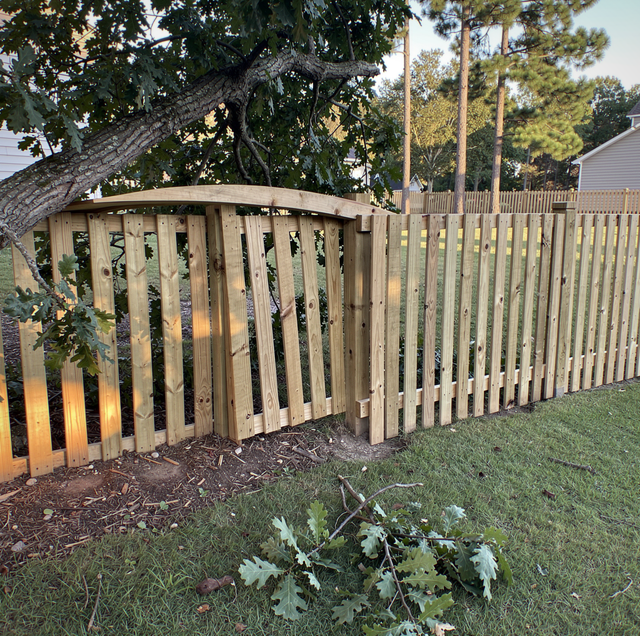
You walk out to the back of your yard and find a limb the size of a small tree lying across your fence. Two bays of pickets are flat, the top rail is bowed, and the thick end is still caught in the canopy above you, holding part of its weight. Your first instinct is to drag it clear yourself. Leave it where it is.
Limbs come down in any month: from wind, from ice, from decay inside a branch, or from dead wood that lets go on a calm afternoon. However yours arrived, the order matters more than the speed. Your fence is third on your list, and the damage you can see from your patio is rarely all the damage you will find.
Who Moves the Limb, and Who Waits
A fence company does not clear trees, and neither should you. The limb belongs to an arborist or a tree crew with the rigging and saws to take it apart in a controlled order, and the fence crew arrives after the last piece is on the ground. Extension guidance advises that broken branches near power lines or high in the canopy should be removed by an arborist. The same guidance calls for a professional arborist when a branch is leaning on a structure, and a fence run is one.
A limb lying across a fence is rarely resting there loosely. Part of its weight may be carried by the pickets and rails under it, and part may still hang from a torn attachment higher up. Take away the wrong piece and the load shifts at once.
A limb hung in the tree, or bent across the fence under tension, can drop or spring back the moment anyone disturbs it, so leave it untouched and let an arborist cut and lower it before any fence work begins.
Power lines move everything up the list. If the limb, or the fence it landed on, touches or sits near any overhead line, stay back, keep everyone else back, and call the utility company before the arborist. The guidance is blunt: for safety reasons, always let the utility company handle broken limbs or tree damage around power lines. An aluminum or chain-link run in contact with a line can carry current well past the spot where the limb hit, so the whole fence stays untouched until the utility has cleared it.
The Bay That Took the Hit
A falling limb delivers its full load to a small area at once, and the bay beneath it shows the obvious damage: pickets snapped at the rail line, boards split lengthwise, a top rail cracked mid-span where it had the longest reach between posts.
Pickets are the covering, and replacing them is the smallest part of most limb repairs. The rails behind them matter more. A rail that bent far enough to crack may look straight again once the weight comes off, with the split running along the grain on the back face where you can't see it from your side. A rail pulled off at one end leaves the bay hanging from a single post, and that bay will not hold its shape for long.
With the limb off, check the ground under that bay. A limb that hit hard enough to drive the bottom of the bay down can leave pickets pressed into the dirt or mulch, and wood held against wet ground rots from the bottom long after the rest is repaired. If you see bottom ends buried, those boards belong in the repair even when they look whole.
On an aluminum run, the same strike bends pickets and kinks the rails into a shallow V instead of splitting anything. On chain link it flattens the top rail and stretches the fabric, which then hangs slack across two or three posts.
The Bays on Either Side
Rails do not stop at the post. On most wood fences, each rail spans one bay and meets the next at a shared post, so when the struck bay was driven down and back, it dragged the ends of its neighbors with it. Sight along the top of the run from one end once the limb is gone: the bays either side often lean out of plane, pickets near the shared post pop loose from the rail, and the top line dips toward the impact point.
You will catch that dip from the end of the run more easily than from the middle of your yard, since a small drop spread over two bays hides face on and shows plainly along the line.
This spread is why a repair scoped to the flattened section alone tends to come up short. The neighboring bays often come back with new rails and a few pickets, but they have to be checked, because a bay pulled out of line and left alone keeps drifting.
What Presses on the Posts at Either End of the Strike?
Once the limb is off, the load that remains in the fence is carried by the posts. The two posts bracketing the struck bay took the weight as a twist as well as a push, because a limb rarely lands dead center. A post twisted in its footing can look plumb from the front and still be turned a few degrees, with a sliver of open ground along one face of the concrete collar where the soil let go. The bent rails still attached to it keep pressing it in the direction it was pushed, so it will not drift back on its own.
A post cracked at grade or just above it is finished. It took the lever of everything standing above it, and the crack usually runs up the grain from the ground line. A post that leans a little after a strike is the same failure at an earlier stage: the footing has lost its grip on the soil, and propping the post will not restore that grip. The fix for either is the same. The post is pulled, the old footing is dug out, and a new post is set in concrete so the repair holds.
A long limb that landed across several bays spreads this twist over more posts, each one taking less. Those posts often come through sound, but each gets looked at before new rails go on.
Matching What You See to What Broke
Once the limb is gone and any line is cleared, a slow walk along the run from a few feet back sorts most of the damage. Use this as a map, not a repair plan; everything in the right-hand column is someone else's work.
| What you see | What it usually means | Who handles it |
|---|---|---|
| Limb still hung in the canopy or bowed across the fence | Stored tension that can release without warning | Arborist |
| Any wire down, sagging, or touching the limb or fence | Electrical hazard along the whole run | Utility company |
| Pickets snapped or split under the limb | Direct strike, usually the smallest repair | Fence crew |
| Rail cracked at mid-span or pulled off one end | The bay has lost its frame | Fence crew |
| Bays beside the strike leaning out of plane | Load dragged through shared rails and posts | Fence crew |
| Post turned in the ground, open gap along one side | Twisted in its footing; bond with the soil broken | Fence crew |
| Post cracked at or just above grade | Took the full lever; will not carry new rails | Fence crew |
The top two rows are the only ones that change what you do in the first hour. The rest can wait for a crew that knows what to look for.
One kind of damage no walk will show you. A post can crack below grade, inside or just under its concrete collar, and still stand straight while the rest of the run holds it up. The clue is a post that looks fine and moves when a crew puts weight on it, which is one more reason the posts get checked by hand rather than by eye.
How a Repair Is Matched to the Run
A good repair starts with the cause beneath the surface, not by standing the fence back up and hoping. Damaged boards, pickets, and rails are replaced and matched to the existing fence as closely as the materials on the market still allow: height, picket profile, spacing, the cap board if there is one, and which side faces out all carry over.
New wood beside an older run will not match in color on day one. Fresh pressure-treated lumber starts out lighter or greener than boards that have weathered for years, and the difference narrows as the new wood weathers.
Posts get the most attention. Any post that twisted, cracked, or loosened is pulled, its old footing is dug out, and a new post is set in concrete, so the new rails hang from something sound instead of a post that already failed once. On aluminum, bent pickets and kinked rails usually mean a new panel, and a post bent at the base is replaced with it. Chain link is often brought back with a new top rail and re-tensioned fabric when the only other damage is stretched fabric.
Expect the work to run in that order too. The damaged bays come out, the posts go in, and the rails and pickets follow once the new posts are solid, so your run may stand open for a short stretch between the post work and the finished section.
When most of a run was already near the end of its life, a limb can tip the job from repair toward replacement, and an honest crew will point that out before patching three bays of a fence that is failing everywhere.
The Call Before Anyone Touches the Limb
Before a saw, a rope, or a hand goes near it, the first call depends on one thing: whether any wire is involved. If a line is down, sagging, or anywhere near the limb or the fence, the utility company is the call, and nobody else starts until it has finished. If no line is involved, the call goes to an arborist, and it is worth describing where the limb rests, whether its heavy end is still hung up, and whether the fence is holding part of its weight. The fence call comes last, once the limb is on the ground in pieces and the run can be walked.
Frequently Asked Questions
Yes, while you stand well clear. Take a wide shot of your whole run and closer shots of where the limb rests on each post. Once the arborist cuts it up, the scene changes, and your photos let the crew separate strike damage from removal damage.
If your gate post shares rails with a bay pulled out of line, it can be tipped without looking damaged. The first symptom is the latch: the gate swings shut but misses its keeper, or it drags at the far corner. Once the limb is gone, try the latch on any gate near the strike and mention what you find when you call.
Sometimes. A heavy limb cut into pieces has to come down somewhere, and your fence line is often the easiest landing zone. Tree crews can lower sections on ropes where something below is worth protecting, so let your arborist know which parts of the fence you want saved before the first cut.
A limb that broke from decay or dead wood is often not the only weak one. Ask your arborist to look over the rest of the canopy while on site. Any limb you were already worried about is better taken down before the fence is repaired, so your new section is not struck the same way.
Treat your yard as unfenced until your repair is done. The gap under the limb is obvious, but a dog will also find a bay pushed far enough out of line to open a space at the bottom. Keep your dog leashed outside and away from the limb and the work area while you wait.
Posts close to a mature hardwood often land among its roots. When the crew digs out an old footing and resets a post, a large root in the hole can mean shifting the post a few inches along the line or spacing the bays differently. Cutting a major root can weaken a tree you are keeping, so ask your arborist about the roots near the fence before the dig. A tree you are taking down leaves a stump and root mass behind, which the crew works around or the arborist grinds out.
Once the arborist has the limb down — have the whole run walked, not only the bay it hit, with posts either side checked for twist and new rails and pickets matched to your fence. Crusberg Fence serves Yorktown and the Virginia Peninsula. Call (757) 508-0538.